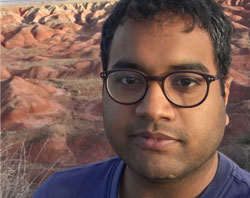
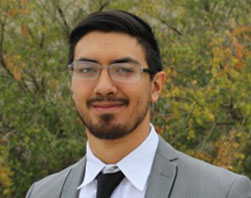
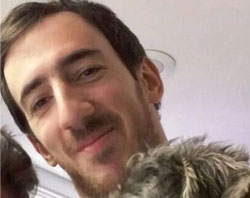
Hao earned his PhD from the CAEE department at the University of Texas at Austin. His research centers around traffic flow modeling and optimization, traffic signal control, and shared mobility. After graduation, Hao worked as a postdoctoral researcher at the Pennsylvania State University. Hao joined the Jackson State University as an assistant professor in August 2024.
Gracie is a Masters student in the CAEE department of the University of Texas at Austin. Originally from Nashville, Tennessee, she earned her B.E. in Civil Engineering from Vanderbilt University in May 2023, where she contributed to a large-scale field experiment testing the effects of mixed autonomy on fuel usage. Her research interests are broadly in applications of transportation cyber-physical systems for improving transportation safety and equity.
Joaquin Hernandez was a full-time researcher working for the Center for Transportation Research (CTR) at the University of Texas, Austin. His research involved developing a novel system for pavement deflection using high-speed laser-sensors. Other work pertain to pavement friction, noise and texture in flexible and rigid pavement. Aside from research, he enjoys cooking, traveling and is a car enthusiast.
Ekin was an undergraduate student in the CAEE Department of UT Austin. Ekin was born and raised in Istanbul, Turkey before moving to Texas for high school. His research interests include vehicular aerodynamics, network optimization, traffic simulation, autonomous vehicles, and data science. He likes talking politics, playing soccer and basketball, traveling, and hanging out with his dog Lunita.
Hassan earned his PhD in Civil Engineering from the University of Texas at Austin. During his PhD, Hassan worked on state estimation of distributed parameter systems with team of autonomous mobile sensors and developed an autonomous rover to detect and classify microplastics on beaches in real-time. Hassan is currently a postdoctoral fellow and develops AI surrogate models for monitoring and control of complex systems described by PDEs.
Suyash was a graduate student in the CAEE department of UT Austin. He graduated with a Bachelor’s degree in Civil Engineering from Indian Institute of Technology, Roorkee. His research interests include traffic simulation, traffic control, optimization and ITS. He enjoys cooking, reading and playing video games.
Kun Qian’s research interests are in recommendation systems and multi-agent systems related problems. Kun is now an Applied Scientist working in Amazon Search Science and AI department.
Kapil was a graduate student in Electrical & Computer engineering. His research focuses on developing AR based traffic safety system. These systems will work on fusing real-time video and IMU sensing on-board smart glasses like Google Glass, ODG-R7 etc. to come up with a collision prediction and prevention system. He is a coding geek and helps the group in various aspects of embedded systems, from bringing up the hardware to write software for it. His other project is developing GPS-less (IMU based) tracking systems which our group works on with Texas Department of Transportation (TxDot). His other interests include Artificial Intelligence, developing cool things with chip size computers like Raspberry PI.
Originally from Houston, Arthur earned his Bachelor’s in Aerospace Engineering at the University of Texas, Austin. He has a particular interest in control systems and automation. He has been tinkering with UAVs since he started school at UT, and tries to apply everything he learns towards experimenting with and improving UAVs. He is also cofounder of a drone-based delivery startup.
Ofer’s research concerns developing a control supervisor for UAVs. By using classical reachability techniques he is able to predict what state the aircraft will be in and assist in preventing it from getting into unsafe scenarios when it’s controlled either by a human operator or by its autopilot. His goal is to use this control system to allow him to use the UAV in real-time flood monitoring. In this project machine-learning methods are used to tackle the computational challenges involved in the real-time reachability problem.